
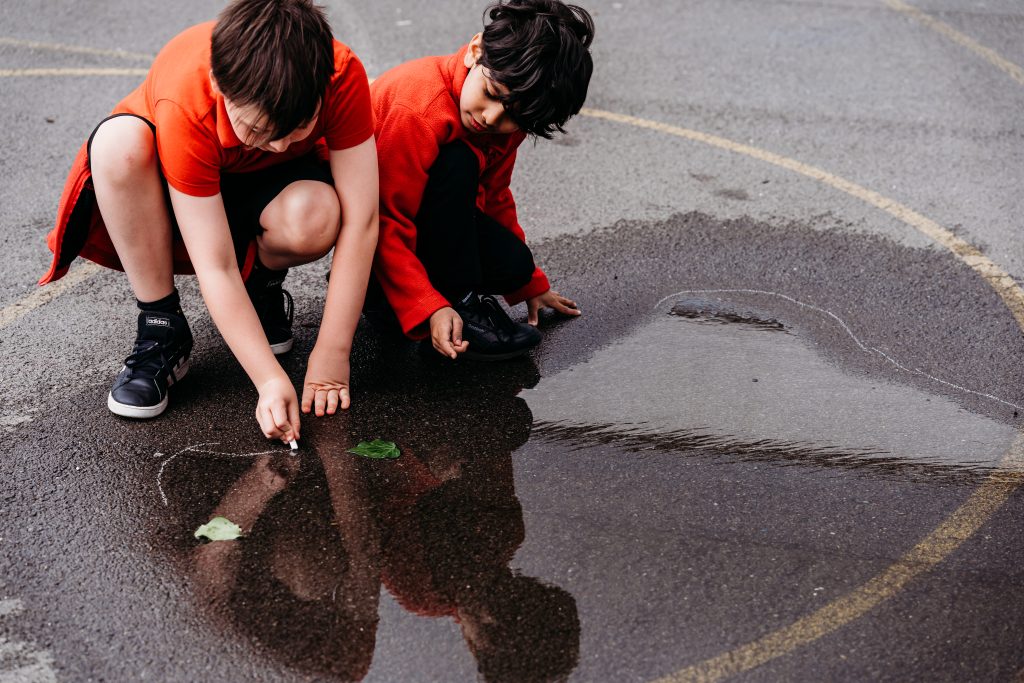
Here we suggest science topics and activities that lend themselves to outdoor learning and the benefits for learners. We offer guidance to get you started, highlight examples and link to some of PSTT’s outdoor learning resources.
Making the most of the outdoors to teach and learn science
Which curriculum topics are best taught outdoors?
Outdoor learning is essential for some science topics (seasons) but can be beneficial for other topics too.
Use sticks to create skeletons.
Use drama to model pollination.
Walk the route of the circulatory system in the playground.
Air resistance can be experienced by holding a sheet or parachute when running.
Find out where mains electricity comes from in your locality.
Experience the relative motion of the Earth, moon and Sun.
Observe the effects of an irreversible reaction by making film cannister rockets.
Blow bubbles to measure the direction and speed of the wind.
Download our Activity List to compare with your curriculum.
Benefits
- Supports mental health and well-being
- Deepens connections with nature
- More possibilities and opportunities for inclusive activities
- Certain concepts are more relevant and easier to understand in an outdoor environment
- Opportunities for children to see how science is relevant in the real world and in their locality
- More space for children to model scientific concepts and processes
- Child development is enhanced – confidence, social skills, communication, motivation, cooperation, physical skills, as well as knowledge and understanding
How do I prepare?
You must risk assess all the activities you intend to carry out following the advice of your safety advisor. This is likely to be CLEAPSS if you are in England, Wales or NI, or SSERC in Scotland. Don’t worry, this does not have to be a time-consuming, form-filling exercise – just read the guidance provided by CLEAPSS or SSREC or your employer’s Health and Safety Advisor. It’s very comprehensive and easy to follow.
What do I need to take with me?
- Children’s medication
- To respond to any unexpected items: good quality washing up gloves, heavy-duty bin bags, 2 small cones (but check CLEAPSS or SSERC for current guidance).
- A bucket! Or rather many buckets – one per child. These can be used to carry equipment outside for investigations, to collect things or to sit on to create an outdoor classroom.
- To record learning, consider taking clipboards, whiteboards and pens, cameras, tablets.
What does outdoor learning look like?
Here are examples of outdoor science learning.
- Early Years: Bubble Blowers, Mud kitchen menu, Balls down ramps
- KS1: Daisy predictions, Dig and label plants, Material hunter, Seasonal change tree
- KS2: Local survey sorting, Orbit explanation (could be done outside)
You can find more examples by searching ‘examples’ on our Teacher Assessment of Primary Science (TAPS) page.
Try our resources
For younger children:
Shades of colour in the playground – develop observation skills and find out what’s in your local outdoor environment
Leaf looking – develop observation skills and learn to identify some local plants
Senses Walk – develop observation skills using all the senses
Daisy footprints – find out where more/fewer daisies grow locally
Seasonal change – observe a tree over the four seasons
For older children:
Stripes and concealment – investigate insect camouflage locally and find out how scientists have done the same.
Climate models help us plan sports events – investigate what happens to your pulse after exercise and find out why and how climate scientists suggest sports events may need to be adapted in extreme heat
Balloon rockets – investigate friction
Seashore Science – lots of ideas for learning science topics at the beach.
Pollination in a Vase (available in Sketchbook Science) – link science and art with flower surveys and creating collage
Growing Music – investigate the growth of bamboo, its properties and pitch (sound) by making a musical instrument
All ages:
A series of adaptable outdoor trails covering a wide range of science topics for ages 4-12 is included in these books:

Further Support
Register for our webinar on 15 March 2027, 16:00-17:30 - Taking Primary Science Outdoors: Simple steps to Confident Practice
Taking Primary Science OutdoorsIf you would like tailored support to develop outdoor science learning in your setting, our Primary Science Mentors will be happy to help.
In-school SupportSafety Notice & Disclaimer
PSTT advises teachers to refer to either the CLEAPSS website or SSERC website for up to date health and safety information when planning practical activities for children.
PSTT is not liable for the actions or activities of any reader or anyone else who uses the information in these resource pages or the associated classroom materials. PSTT assumes no liability with regard to injuries or damage to property that may occur as a result of using the information contained in these resources. PSTT recommends that a full risk assessment is carried out before undertaking in the classroom any of the practical investigations contained in the resources.
All materials are ©Primary Science Teaching Trust (PSTT) and are freely available to download and share for educational purposes. Whilst educators are free to adapt the resources to suit their own needs, acknowledgement of copyright on all original materials must be included. Rights to images included in the resource have been purchased for PSTT use only – as such, these images may only be used as part of this resource and may not copied into or used in other materials.

