

Here, we provide ideas for developing children’s curiosity, talk and observation skills through science. We suggest how you can link science to popular Early Years topics and story books. We highlight examples of Early Years children carrying out science activities, and link to some of PSTT’s Early Years resources.
Encouraging young scientists
Getting started
Supporting science in the Early Years doesn’t require specialist equipment. Simple resources, thoughtful questioning and opportunities to observe closely can help children develop curiosity, confidence and the language to explain their ideas.
Download our Early Years Science Check List to get started.
Resources to make accessible to the children:
- Magnifying glasses
- Plastic pipettes, pots, beakers, jugs, spoons
- Clipboards, paper, pencils
- Magnets, torches, cubes to measure with
- Aprons or lab coats
Effective question prompts:
- What can you see?
- What does it remind you of?
- What do you think will happen next?
- How can we change this?
- What do you already know about…?
- What is the same/different?
- I wonder why / when / how…
- What would happen if…?
Effective question prompts:
- What can you see?
- What do you notice?
- What does that remind you of?
- What do you think will happen next?
- What will happen if…?
Planning Early Years science experiences
Our Provision Maps offer starting points for learning science in an Early Years setting. They are linked to popular storybooks and topics. Here are some to get you started.
What does science in Early Years look like?
In these examples, Early Years children were encouraged to investigate for themselves and to talk about what they found out:
- Pumpkin – I see, notice, wonder – a teacher uses a discussion prompt to encourage child’s close observation
- Sandcastles – a teacher provides a wet and dry sand provocation and a problem to solve to extend thinking and discussion
- Observing biscuits in different liquids – an adult-led activity with a focus on developing observation skills and reporting findings through drawings
- Winter clothes – a practical activity with a focus on helping children to communicate their ideas
- Testing bridge materials – a practical challenge to develop children’s planning and design skills
You can find more Early Years examples by searching ‘Examples’ and ‘Ages 3-5’ on our Teacher Assessment in Primary Science (TAPS) page.
Try some of our resources
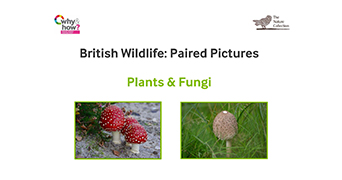
Our Early Years wildlife resources develop children’s observation skills, reinforce vocabulary, and provide opportunities for children to think and talk about nature.
Here are some to get you started and there are more available in our Play Observe & Ask in Early Years resources.


Further Support
Early Years lessons are available within our Festive Science Lessons (available from 23 November 2026), Online Science Days (8-12 March 2027) and Summer Science Lessons (from 26 April 2027).
EventsIf you would like tailored support to develop science in your Early Years setting, our Primary Science Mentors will be happy to help.
In-school SupportSafety Notice & Disclaimer
PSTT advises teachers to refer to either the CLEAPSS website or SSERC website for up to date health and safety information when planning practical activities for children.
PSTT is not liable for the actions or activities of any reader or anyone else who uses the information in these resource pages or the associated classroom materials. PSTT assumes no liability with regard to injuries or damage to property that may occur as a result of using the information contained in these resources. PSTT recommends that a full risk assessment is carried out before undertaking in the classroom any of the practical investigations contained in the resources.
All materials are ©Primary Science Teaching Trust (PSTT) and are freely available to download and share for educational purposes. Whilst educators are free to adapt the resources to suit their own needs, acknowledgement of copyright on all original materials must be included. Rights to images included in the resource have been purchased for PSTT use only – as such, these images may only be used as part of this resource and may not copied into or used in other materials.

